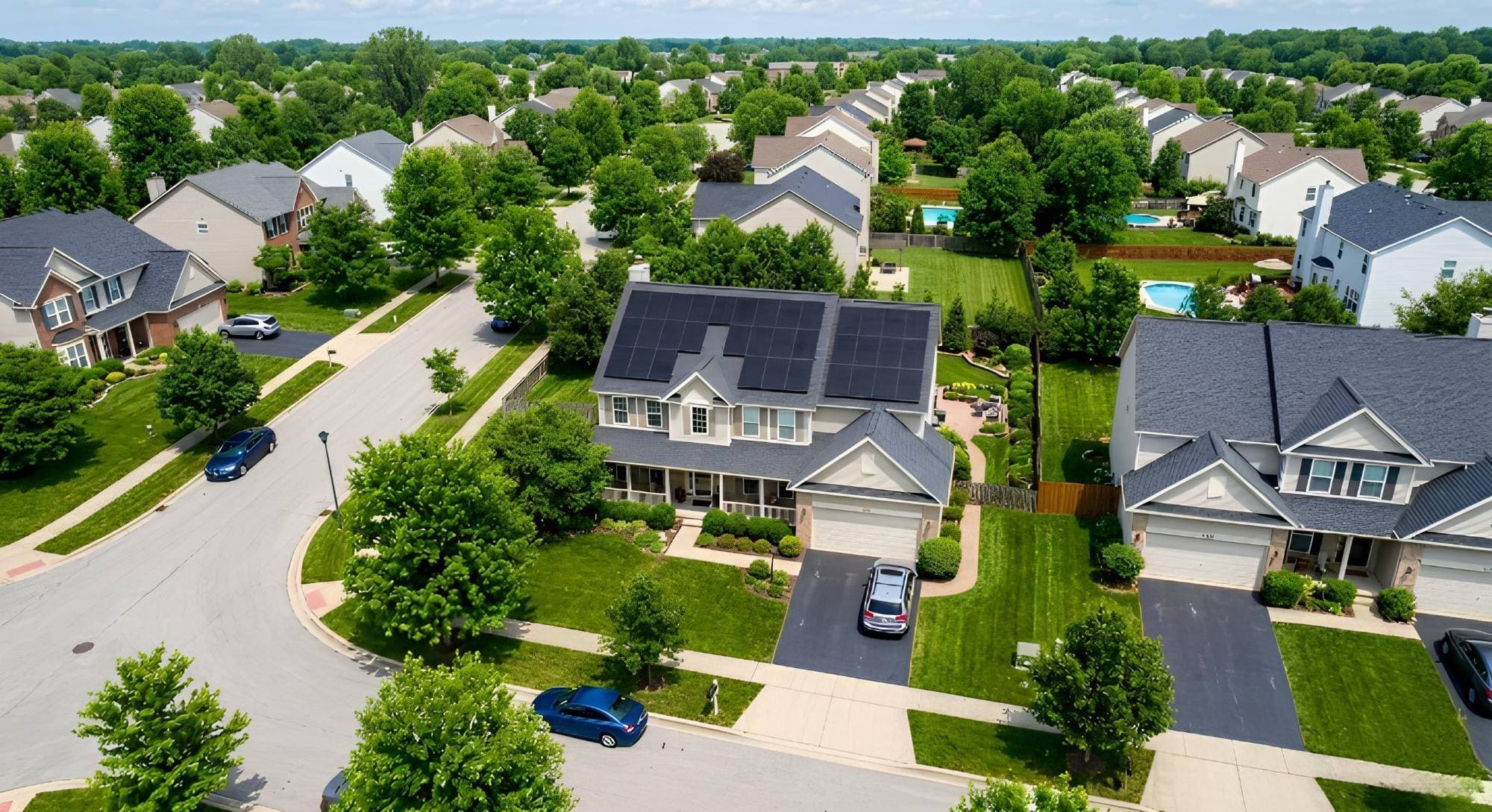
Solar panel installation in Harvard, IL
See what solar could save your Harvard home with the ComEd solar rebate, Illinois Shines incentives and $0-down options. Free, no-obligation quotes from installers serving McHenry County.
Free, no-obligation quotes. Savings vary by home and utility. $0-down offers are leases or PPAs and are subject to approval.
By IL Solar Deals · Updated October 2026 · How we research
Quick answer
Is solar worth it in Harvard, IL?
For many homes, yes. With a $150 monthly bill, we estimate a 8.0 kW system costs about $8,000 after the ComEd rebate and Illinois Shines and pays for itself in about 6.2 years. Panels in Harvard produce roughly 1,190 kWh per kW each year on an unshaded, south-facing roof.
How much does solar cost and save in Harvard?
- Electric utility
- ComEd
- County
- McHenry County
- Population (2020)
- about 9,469
- Solar output per kW
- ~1,190 kWh/year
- System for a $150/mo bill
- ~8.0 kW (20 panels)
- Est. utility rebate
- $2,400
- Est. Illinois Shines value
- $14,400
- Est. net cost / payback
- $8,000 / ~6.2 yrs
Estimates for a cash purchase on an unshaded, south-facing roof with a $150 monthly bill. Your roof and rate plan will change the numbers. How we estimate
What would a solar estimate look like for a Harvard home?
Estimates for Harvard homes at four common bill sizes. Bigger bills need bigger systems that cost more up front, but payback stays about the same, because the ComEd rebate and Illinois Shines grow with system size too. Systems over 10 kW get somewhat different Illinois Shines prices, so treat the largest size as a rough guide. For prices by system size, see how much solar costs in Illinois.
| Monthly bill | System size | Panels | Roof space | Cost after incentives | Payback |
|---|---|---|---|---|---|
| $100/mo | 5.2 kW | 13 | ~270 sq ft | $5,100 | 6.1 yrs |
| $150/mo | 8.0 kW | 20 | ~420 sq ft | $8,000 | 6.2 yrs |
| $200/mo | 10.8 kW | 27 | ~570 sq ft | $11,200 | 6.5 yrs |
| $300/mo | 16.8 kW | 42 | ~880 sq ft | $17,300 | 6.4 yrs |
How does solar work with ComEd in Harvard?
Harvard is a McHenry County city in the county's far northwest corner, near the Wisconsin state line.
Most homes in Harvard get their electricity from Commonwealth Edison (ComEd). That matters for solar, because your utility sets how you're credited for the power your panels send back to the grid and pays the state-required solar rebate.
For systems connected since 2025, ComEd credits exported power at the supply rate, so the best Harvard systems are sized to cover what your home uses during the day. In exchange, ComEd pays about $300 per kW up front for systems with a smart inverter. See the full ComEd solar guide.
These estimates apply to homes with mailing addresses in Harvard, including ZIP code 60033.
Compare costs across nearby towns on the McHenry County solar installation page.
Wondering why your ComEd bill has climbed? See why ComEd bills are so high in 2026.
Is your Harvard home a good fit?
About 61% of homes in Harvard are owner-occupied, and the median owner-occupied home is valued at $174,000, compared with 67% and $263,300 statewide, according to the U.S. Census Bureau (2019-2023 estimates).
- You own the home. Rooftop solar requires owning the roof.
- Your roof gets sun for most of the day on its south, west or east side, without heavy tree shade.
- Your roof has some life left. Replacing worn shingles before installing saves a removal fee later.
- Your ComEd bill is regularly over about $100 a month, or you're adding an EV or heat pump.
Not sure? A specialist can check satellite imagery of your Harvard roof as part of your free quote.
How many Harvard homes are going solar?
Illinois Shines, the state's solar incentive program, had approved 173 home-sized solar systems (25 kW or smaller) in ZIP code 60033 as of September 2026, including 28 in the past 12 months.
About 39% of them are owned by the homeowner, paid in cash or with a loan, and the rest are leases or power purchase agreements, compared with 44% owned statewide. The typical system is 7.6 kW, the same as the 7.6 kW typical across Illinois. To compare the two ways to pay, see solar lease vs. buy in Illinois.
Harvard ranks #106 of 204 towns with at least 100 projects for the share of systems homeowners own. See how Illinois towns compare.
Counts are applications approved by the Illinois Commerce Commission, and some may not be installed yet. ZIP codes follow mail routes rather than town borders, so they can include homes just outside Harvard. Source: Illinois Shines: Project application reports (ICC-approved Part I applications). How the program works: Illinois Shines explained.
Using these numbers? Please cite IL Solar Deals, "Solar in Harvard, IL," www.ilsolardeals.com/solar-panels/harvard-il. Every town's figures are in our town solar data (CSV).
How do I compare solar companies in Harvard?
Check these before you sign with any solar company serving Harvard:
- Illinois Commerce Commission certification. Installers need the state's distributed generation installer certification for your system to be net metered.
- Illinois Shines Approved Vendor or Designee. Only registered companies can pass along the Illinois Shines incentive. Look them up on illinoisshines.com and make sure they aren't suspended.
- Local registration. Many Illinois towns require contractors to be licensed or registered locally, so ask whether the company is set up to pull permits with the City of Harvard.
- Two or three quotes compared on price per watt, equipment, warranties and how each handles the ComEd rebate. Our solar quote checker flags high prices, and what a quote should include walks through each line.
- No pressure. Walk away from same-day signing deadlines, "free solar" pitches and quotes that still subtract the expired federal tax credit. See spotting solar scams.
For more, see how to choose a solar installer in Illinois, or request a free quote for your Harvard home from one of our trusted Illinois partners.
Can I add battery backup to solar in Harvard?
Yes. A battery stores your solar power and keeps chosen circuits running when the ComEd grid goes down, which standard solar alone can't do. ComEd pays about $300 per kWh of battery capacity, around $4,050 for one 13.5 kWh battery, if you enroll it in the utility's virtual power plant program.
What Harvard has seen:
- Early on August 6, 2024, storms downed trees and power lines across McHenry County, and Thayer Road in Harvard was closed for a time because of downed wires and poles. See whole-home battery backup.
- On June 3, 2025, the National Weather Service received a report of downed power lines and tree branches in Harvard as storms crossed McHenry County. See does solar work in a power outage?
- On August 10, 2021, a 67 mph wind gust was measured near Harvard, and ComEd had about 29,000 McHenry County customers without power that evening.
- Essentials: one battery usually covers the refrigerator, lights, internet, sump pump and furnace fan.
- Whole home: running central air, an electric range or a well pump usually takes two or more batteries.
- No upfront cost: solar and a backup battery can come together through a lease or power purchase agreement with $0 down. The company owns the system and you pay monthly instead. See $0-down solar and battery backup.
- Adding later: many batteries can be added to an existing solar system, so ask installers about it even if you start with panels only.
- On a private well: an outage also stops your well pump, so make sure the battery can start it. See battery backup for homes on well water.
See what a home battery costs in Illinois, how the virtual power plant works and Powerwall 3 vs. Enphase vs. FranklinWH.
What permits and paperwork does solar need in Harvard?
- In July 2024 Harvard renewed its electric aggregation agreement with MC Squared Energy Services for a 24-month term, October 2024 through October 2026, at a price equal to the ComEd rate. Homes with solar, another supplier or hourly pricing were left out of the program. See Price to Compare.
- 1
Building and electrical permits
Your installer applies to the City of Harvard for the building and electrical permits, and a local inspector checks the finished work.
- 2
Illinois Shines application
Your installer registers the system with Illinois Shines, and you review and sign the program's disclosure form before installation.
- 3
ComEd interconnection and rebate
ComEd approves the connection, updates your meter and grants permission to operate; then your installer files for the $300/kW rebate.
- 4
Property tax form
File form PTAX-330 with the McHenry County assessment office (the chief county assessment officer) so the system doesn't raise your assessment. See how Illinois taxes homes with solar.
In a neighborhood with a homeowners' or condo association? Illinois law stops associations from banning rooftop solar. See Illinois HOA solar rules. For timing, see how long solar installation takes.
Local sources: Shaw Local Northwest Herald: Overnight storms down trees, power lines in McHenry County (2024); Shaw Local Northwest Herald: Trees, wires down after storms zip across McHenry County (2025); Shaw Local Northwest Herald: Outages remain widespread in McHenry County (2021); City of Harvard: Electrical aggregation information (2024)
How much could solar save your Harvard home?
Get an instant solar estimate for your Harvard home: enter your bill to see a system size, cost after incentives and payback.
Your estimate
- System size
- 8.0 kW
- about 20 panels
- Yearly production
- 9,520 kWh
- vs. about 9,529 kWh used
- First-year savings
- $1,285
- about $107/month
- Payback
- 6.2 years
- $43,800 saved over 25 years
| Estimated cost before incentives | $24,800 |
|---|---|
| ComEd solar rebate | −$2,400 |
| Illinois Shines REC valueUsually paid to your installer and passed on as a lower price. | −$14,400 |
| Estimated net cost | $8,000 |
Planning estimate only, not a quote. Assumes a south-facing roof, cash purchase and half of production used at home. Real numbers depend on your roof, equipment, rate plan and current program prices. How we estimate
Illinois incentives that still apply in 2026
$300/kW utility rebate
ComEd pay a one-time rebate of about $300 per kW for new systems with a smart inverter, around $2,100 on a 7 kW system.
Learn more →Illinois Shines
The state buys the renewable energy credits your panels create. Installers usually pass that value to you as a lower price.
Learn more →Net metering credits
Power you send back to the grid still earns bill credits. New systems are credited at the supply rate.
Learn more →$0-down options
With the federal homeowner credit gone, leases and PPAs can still pass along a business tax credit as a lower rate.
Learn more →
Program details last reviewed October 2026. Rules and amounts change, so confirm current terms with your installer.
How it works
- 1
Enter your ZIP
We confirm your home is in Illinois and which utility serves it.
- 2
Answer a few questions
Your typical electric bill and your roof. It takes about two minutes.
- 3
Talk to a local specialist
An Illinois installer models your real savings, including Illinois Shines and your utility rebate. You decide what happens next.
Where else near Harvard can you get solar quotes?
What should Harvard homeowners know before going solar?
- How much do solar panels cost in Illinois?
What solar costs in Illinois in 2026 by system size and town, before and after the ComEd or Ameren rebate and Illinois Shines, plus batteries and payback.
- Why is my ComEd bill so high?
ComEd's supply price rose from about 6.5¢ to 10.4¢ per kWh after grid capacity prices jumped tenfold. Every reason your bill rose and what cuts it.
- How much does a home battery cost in Illinois?
What battery backup for a home costs in Illinois in 2026: price per kWh, one or two batteries after the $300/kWh ComEd and Ameren rebate, and quote tips.
- Battery backup for your sump pump in Illinois
Storms that flood basements often knock out power too. How a home battery or backup pump keeps an Illinois sump pump running, what each costs and what to ask.
- Illinois solar incentives in 2026
Illinois solar incentives in 2026: ComEd and Ameren solar and battery rebates and how to claim them, Illinois Shines, Chicago permits and property taxes.
- How to choose a solar installer in Illinois
The certifications an Illinois solar installer must have, how to check one with Illinois Shines, what to compare between quotes, and red flags to avoid.
- Solar lease vs. buying in Illinois
Compare buying, financing, leasing and PPAs for solar in Illinois now that the federal homeowner credit is gone, and see who each option suits best.
- What an Illinois solar quote should include, line by line
An Illinois solar quote line by line: system size, equipment, production, price per watt, incentives, financing, warranties and your right to cancel.
- Solar for a home with a pool or hot tub in Illinois
How much electricity a pool pump, pool heater or hot tub uses in Illinois, how much extra solar it needs, and the upgrades that cut the load first.
- Tesla Powerwall 3 vs. Enphase vs. FranklinWH for Illinois homes
Tesla Powerwall 3, Enphase IQ Battery 5P and FranklinWH aPower 2 compared for Illinois homes: capacity, power, warranties and the ComEd/Ameren rebate.
Harvard solar FAQ
Who is the electric utility in Harvard, IL?
Most homes in Harvard are served by Commonwealth Edison (ComEd). Some addresses near town edges may be on a municipal utility or electric co-op, so check the name on your bill.
Are there solar rebates in Harvard?
Yes. ComEd customers in Harvard can get a one-time rebate of about $300 per kW for new solar systems with a smart inverter, around $2,100 for a 7 kW system, plus Illinois Shines incentives.
How much do solar panels cost in Harvard?
For a home with a $150 monthly bill, we estimate a 8.0 kW system at about $24,800 before incentives, or about $8,000 after the ComEd rebate and Illinois Shines. Leases or PPAs can bring upfront cost to $0. Try the solar savings calculator, or get a free quote for real numbers on your Harvard home.
How much electricity do solar panels produce in Harvard?
About 1,190 kWh per year for each kW of panels on an unshaded, south-facing roof, so a 8.0 kW system would make roughly 9,520 kWh a year. Shade, roof direction and pitch can lower that.
Do I need a permit for solar in Harvard?
Yes. Rooftop solar needs a building and electrical permit from your local building department (the city or McHenry County), plus interconnection approval from ComEd. Your installer normally handles both.
How many homes in Harvard have solar?
Illinois Shines had approved 173 home-sized solar systems in ZIP code 60033 as of September 2026, including 28 in the past 12 months. ZIP codes don't match town borders exactly, so the count can include nearby homes.
Can I get solar battery backup installed in Harvard?
Yes. A home battery can go in with new solar or be added to an existing system, and it keeps chosen circuits running when the ComEd grid goes down. On June 3, 2025, the National Weather Service received a report of downed power lines and tree branches in Harvard as storms crossed McHenry County. See does solar work in a power outage?
Can I get solar and battery backup in Harvard with no money down?
Yes, through a lease or power purchase agreement. A company installs and owns the panels and battery on your Harvard home, and you pay a monthly or per-kWh price instead of an upfront cost. It isn't free, so compare that price with your ComEd bill. See $0-down solar and battery backup.
Is there a battery rebate in Harvard?
Yes. ComEd pays about $300 per kWh of battery capacity, around $4,050 for one 13.5 kWh battery, if you enroll it in the utility's virtual power plant program, which can draw on the battery at set summer peak times.
How do I compare solar companies in Harvard?
Get two or three quotes from installers that are Illinois Shines approved vendors, and compare the price per watt, equipment, warranties and how each handles the ComEd rebate and Illinois Shines. Our solar quote checker flags high prices and other red flags, and our guide to spotting solar scams covers pushy sales tactics.
Get a free solar quote for your Harvard home
Free, no-obligation quote from a trusted Illinois solar partner.